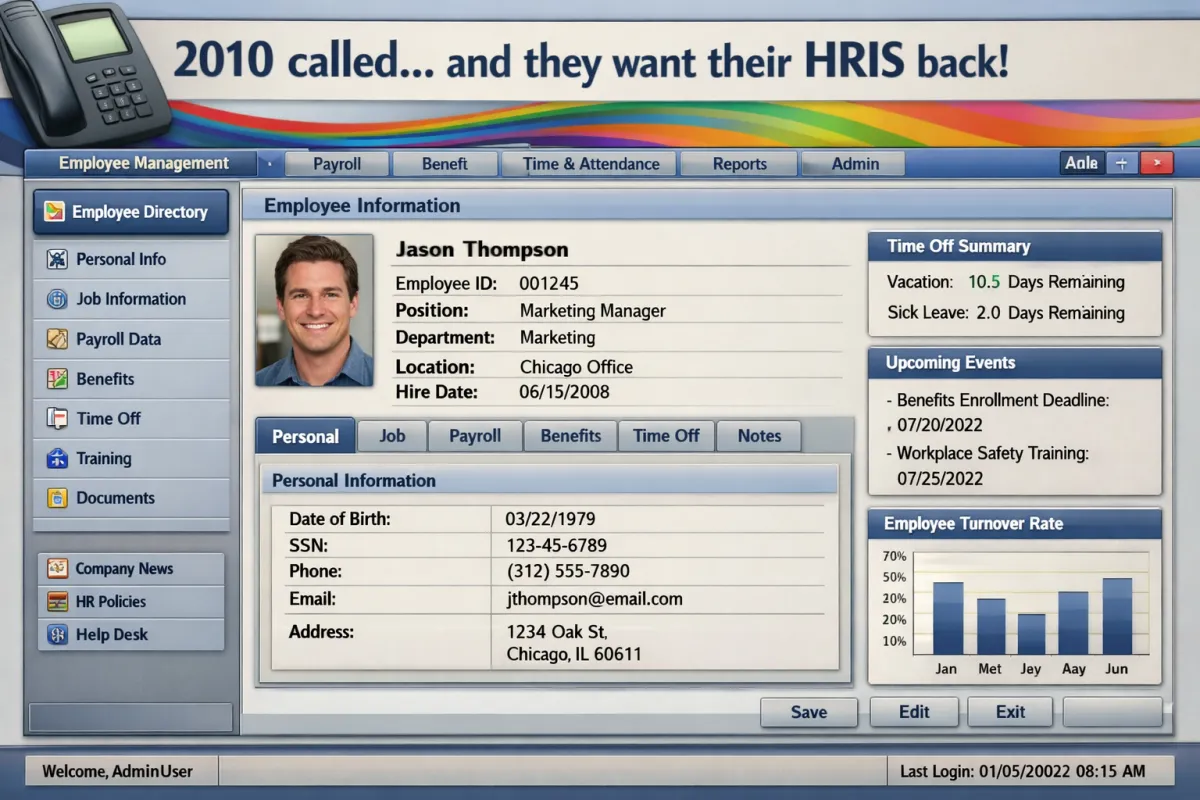
2010 Called. They Want Their HRIS Back.
2010 Called. They Want Their HRIS Back.
A business case for your ROI on an updated HRIS!
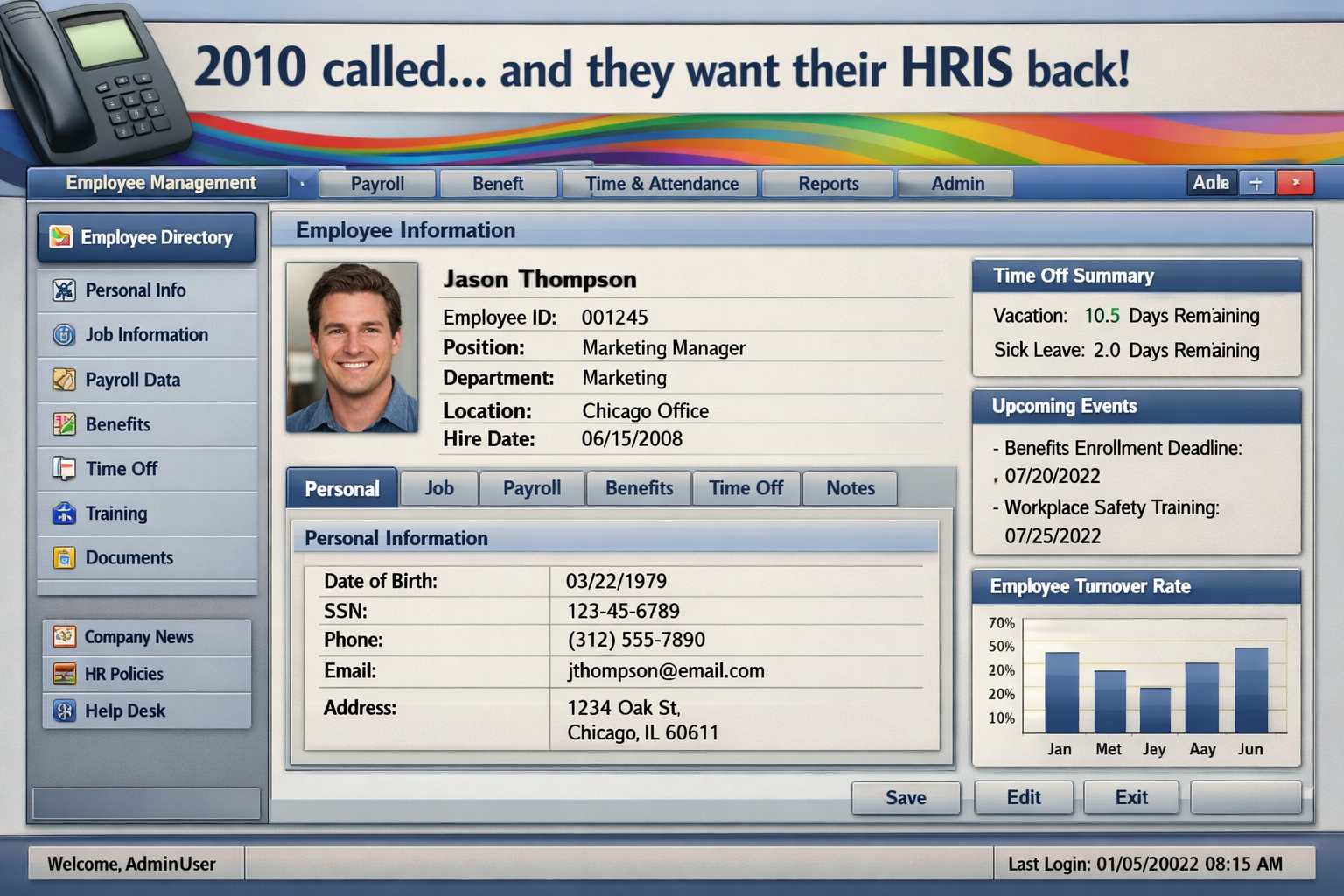
And No, "We Only Have 50 Employees" Is Not a Valid Excuse
Let me paint you a picture. You're an HR professional or a CEO sitting in your office, someone asks you how many open positions you have, what your turnover rate is, and when the last time your employee handbook was updated — and you reach for a spreadsheet. A spreadsheet that Karen in payroll last touched in 2019. A spreadsheet that lives on a shared drive with a folder called "FINAL_v3_REAL_THIS_TIME."
Sound familiar? No judgment. Okay, a little judgment.
Here's the thing — I hear this all the time: "We only have 50 employees, we don't need an HRIS."
Let me translate that for you: "We only have 50 employees, so their experience, our compliance, and our sanity don't matter."
That's not what you meant? Then let's talk about what an outdated or nonexistent HRIS is actually costing you. Spoiler: it's more than the system you're afraid to buy.
The "We're Too Small" Myth
Size doesn't exempt you from people problems. It amplifies them.
In a 500-person company, one HR nightmare gets absorbed by the machine. In a 50-person company, one bad hire, one compliance miss, one payroll error, or one I-9 that's been sitting in a filing cabinet since the Obama administration can crater your entire employee experience — and land you in front of an auditor.
According to SHRM, the average cost to hire a single employee is $4,700, and that's before you factor in the lost productivity during the vacancy and ramp-up period, which can push the real number to 3-4x the position's annual salary (SHRM, 2022). When you have 50 employees, you can't afford to hemorrhage money on inefficiency. And yet, here you are, using a system older than some of your staff members.
What an Outdated HRIS Is Actually Costing You
Let's get into the numbers, because feelings don't move budget conversations — data does. This is how you talk to your CFO or CEO, and this is exactly the argument HR needs to make.
Time is money. Literally.
A 2023 Nucleus Research study found that HR professionals spend an average of 14 hours per week on manual administrative tasks that modern HRIS systems automate. At an average HR Manager salary of $75,000/year, that's roughly $26,250 in annual HR labor cost going straight to tasks a system could handle overnight.
Pain Point Annual Cost Estimate
Manual data entry & spreadsheet management $8,000–$12,000/year in HR time
Compliance errors & audit risk (FLSA, ACA, I-9) $1,000–$50,000+ per incident
Turnover amplified by poor employee experience $50,000–$150,000/year
Onboarding inefficiency (paper forms, delays, errors) $1,500–$3,000 per new hire
Payroll errors & corrections $2,000–$8,000/year
That's a conservative $60,000 to $220,000+ in annual losses — for a 50-person company — because you didn't want to spend $6,000 to $15,000 a year on a modern HRIS.
You do the math. Or better yet, let the system do it for you. That's kind of the point.
The Employee Experience Nobody Talks About
Here's where I'll step off the spreadsheet for a second and get real with you.
Your employees notice. They notice when it takes three weeks to get an offer letter because someone had to mail it. They notice when they still can't access their own PTO balance without calling HR. They notice when their benefits enrollment is a PDF from 2014 that they have to print, fill out by hand, and fax — yes, fax — to someone. (If you're still faxing anything in 2026, we need a separate intervention.)
The employee experience isn't just ping-pong tables and free snacks. It's the daily friction — or lack of it — in how people interact with your company's systems and processes. And when that friction is high, disengagement follows. Gallup's 2023 State of the Global Workplace report found that disengaged employees cost organizations $8.8 trillion in lost productivity globally. Your 50 employees aren't immune to that math.
A functional HRIS reduces friction. Self-service portals let employees update their own information, request time off, and access their documents without emailing Karen. That's not a luxury. That's basic respect for people's time.
The Compliance Argument (AKA How to Scare Your CEO Into Action)
Nothing gets a CEO's attention faster than the word "audit."
Let me give you some ammunition:
The Department of Labor can assess civil penalties of up to $16,000 per I-9 violation (USCIS, 2023). The average small business that gets hit with an FLSA violation pays between $5,000 and $100,000 in back wages and damages. ACA reporting errors can run $310 per return in penalties (IRS, 2024).
A modern HRIS keeps your compliance documentation automated, timestamped, and audit-ready. An Excel spreadsheet keeps your lawyer employed.
Which one do you prefer?
The Strategic Argument: Data You Can Actually Use
Here's where this shifts from transactional to transformational — which, if you've read anything I've written, you know is the whole point.
An outdated system (or no system) means you're making workforce decisions based on gut feelings and tribal knowledge. A modern HRIS gives you data: turnover trends, time-to-fill, cost-per-hire, headcount forecasting, and performance patterns. It gives you the ability to walk into a board meeting or a budget conversation and say, "Our voluntary turnover in Q3 was 18%, concentrated in our operations team, and here's what it's costing us."
That's not HR talking. That's business strategy talking. And that is exactly how HR earns a seat at the table instead of just catering the lunch for it.
Dave Ulrich, the godfather of strategic HR, has spent decades arguing that HR's value lies in its ability to create organizational capability — not push paper (Ulrich, HR from the Outside In, 2012). You can't build organizational capability with a system that predates the iPhone 6.
"But What System Do We Even Need?"
Great question. For 50 employees, you don't need SAP SuccessFactors. You need something functional, intuitive, and scalable. Some solid options in the small-to-mid market space worth evaluating include BambooHR, Rippling, Gusto, and Paylocity — all of which run in the $6–$20 per employee per month range. For 50 employees, you're looking at $3,600 to $12,000 per year.
Compare that to the $60,000+ you're losing in inefficiency. This is not a hard sell. This is a math problem with one obvious answer.
Making the Case: Your 5-Point Business Argument
Whether you're the HR pro convincing your CEO or the CEO convincing your finance team, here's your framework:
1. Show the current cost. Calculate what you're spending in HR labor time on manual tasks. Time-track for two weeks if you have to. Numbers are non-negotiable.
2. Quantify the compliance exposure. Pull your last I-9 audit date, your ACA reporting status, your FLSA classification documentation. If you're sweating right now, that's your argument.
3. Connect to employee experience. Survey your staff. Ask them about friction in HR processes. Let their voices be part of the business case. Your CEO cares about retention. Tie it.
4. Do the ROI math. System cost vs. inefficiency cost. Present it side by side. It writes itself.
5. Show the strategic upside. What decisions could you make with real workforce data? Better hiring? Smarter scheduling? Proactive retention strategies? That's the transformational play.
The Bottom Line
If your HRIS is old enough to have a Myspace page, it's time.
Fifty employees is not "too small" for a functional system. Fifty employees is exactly the right time to build the infrastructure that supports growth, protects your compliance, respects your people's time, and gives HR the data it needs to stop being a support function and start being a strategic driver.
Moving from transactional to transformational doesn't happen on a spreadsheet. It happens when you invest in the tools that make it possible.
The ROI is there. The argument is there. Now it's time to make the move.
Reanette Etzler is The Strategic HR Coach and Founder/CEO of CLT Leadership, LLC. She helps HR professionals and CEOs align HR strategy to drive business results and build exceptional employee experiences. Learn more at www.thestrategichrcoach.com or connect with her on LinkedIn.
Sources:
SHRM. (2022). The True Cost of Hiring. shrm.org
Nucleus Research. (2023). HR Technology Value Matrix.
Gallup. (2023). State of the Global Workplace Report. gallup.com
USCIS. (2023). I-9 Civil Penalty Guidelines. uscis.gov
IRS. (2024). ACA Information Returns Penalties. irs.gov
Ulrich, D. (2012). HR from the Outside In. McGraw-Hill.
About the Author, Reanette Etzler, The Strategic HR Coach


