How to Talk ROI With Your CEO (Without Breaking Into a Cold Sweat)
How to Talk ROI With Your CEO (Without Breaking Into a Cold Sweat)

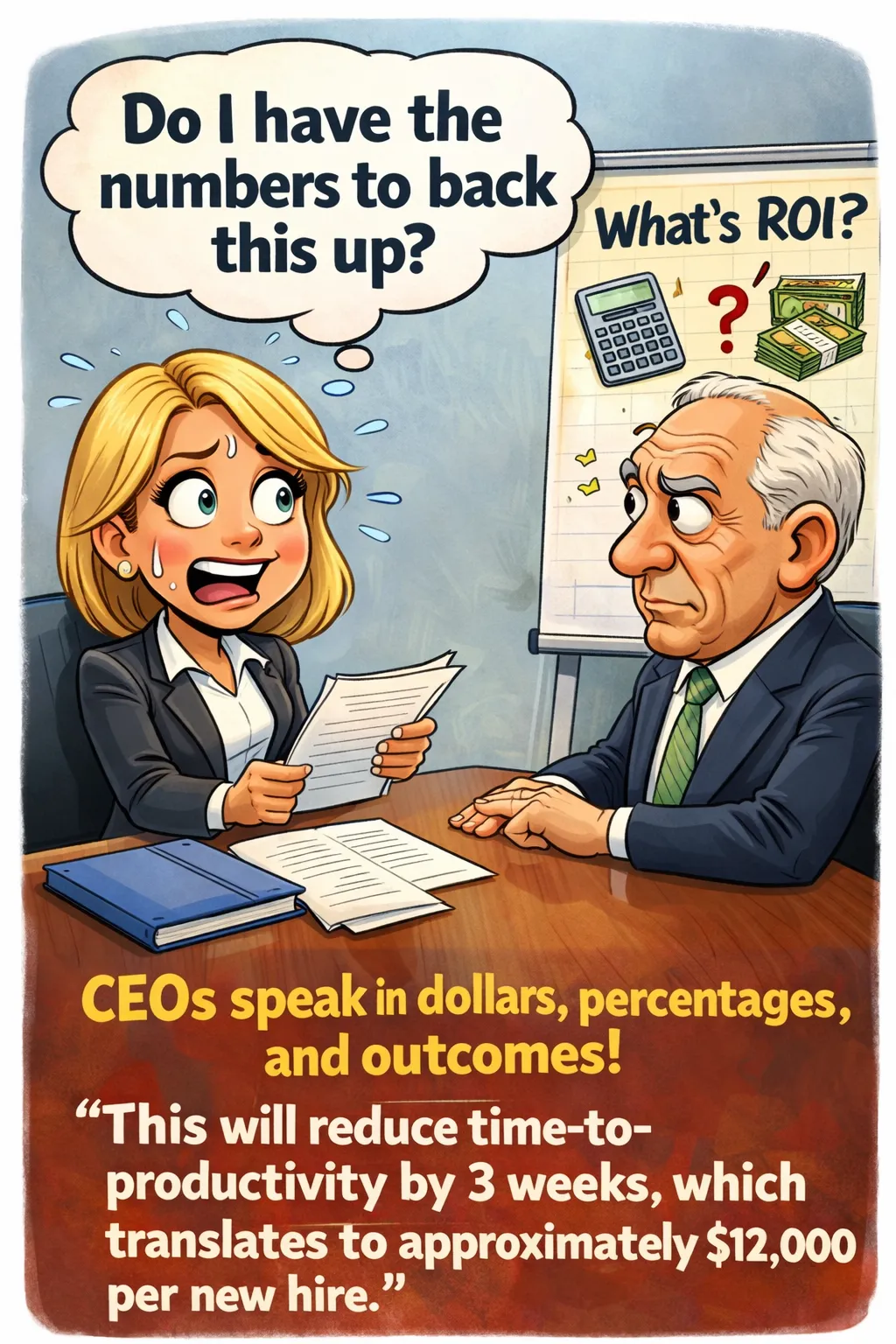
"What's the ROI?"
Four words that send most HR professionals into a spiral of anxiety. We know we do valuable work. We FEEL the impact. But when the CEO asks us to quantify it? Suddenly we're stammering about "employee engagement" and "culture" while watching their eyes glaze over.
Here's the truth: Your inability to speak ROI isn't because HR doesn't have ROI. It's because no one taught you how to translate what you do into your CEO's language.
Let's fix that.
The Translation Problem
CEOs think in three currencies: revenue, cost, and risk. Everything else is noise.
Most HR professionals talk about:
Employee satisfaction scores
Training completion rates
Time-to-fill metrics
Turnover percentages
Compliance status
None of these are wrong. But none of them are in the CEO's language.
When you say "turnover is 18%," your CEO hears a number. When you say "turnover cost us $2.3 million last year and I have a plan to reduce that by $800,000," your CEO hears an opportunity.
The ROI Translation Formula
Here's a simple framework I use with every HR leader I coach:
Step 1: Start with the business outcome, not the HR activity.
Wrong: "I want to implement a new onboarding program."
Right: "I want to reduce 90-day turnover, which will save us $47,000 per avoided departure."
Step 2: Calculate the cost of the problem.
Your CEO needs to understand why this matters NOW. Put a dollar figure on the current pain:
"We lost 12 new hires in their first 90 days last year. At an average cost of $47,000 per departure, that's $564,000 in preventable losses."
"Our time-to-productivity is 12 weeks. Industry standard is 8 weeks. Those extra 4 weeks cost us approximately $12,000 per hire in delayed revenue contribution."
Step 3: Project the improvement.
Be conservative. Overpromising kills credibility.
"If we reduce 90-day turnover by just 50%—from 12 departures to 6—we save $282,000 annually."
Step 4: Show the investment vs. return.
"The new onboarding program will cost approximately $45,000 to implement and $15,000 annually to maintain. That's a first-year ROI of 370%."
Want a FREE Workbook to get you started?
Five Numbers Every HR Leader Should Know
Before your next CEO conversation, know these numbers cold:
Cost per hire. Include recruiting costs, interviewing time, onboarding, training, and productivity ramp-up.
Cost of turnover. The general formula is 50-200% of annual salary depending on the role. Calculate yours specifically.
Revenue per employee. Divide total revenue by headcount. This helps you contextualize workforce investments.
Time-to-productivity. How long before a new hire is fully contributing? Every extra week has a cost.
Absence rate cost. Unplanned absences impact productivity and overtime. Know your number.
The Conversation Starter Template
Here's exactly how to open your next CEO conversation:
"I've identified an opportunity to [save/protect/generate] $[X] by [specific outcome]. Here's what I'm seeing and what I recommend."
Examples:
"I've identified an opportunity to save $400,000 annually by reducing customer-facing turnover. Here's my 90-day plan."
"I've identified an opportunity to protect $2.1 million in revenue by addressing our skills gap in AI readiness before our competitors do."
"I've identified an opportunity to generate an additional $150,000 in productivity by accelerating our time-to-competency for new hires."
Notice what's NOT in these openers: the words "HR," "initiative," "program," or "employee engagement."
One Final Mindset Shift
Stop thinking of yourself as someone who "does HR." Start thinking of yourself as someone who solves business problems through people strategy.
When you make that mental shift, the ROI conversations become natural—because you're not defending HR's existence. You're showing your CEO exactly how you help them win.
The HR Hangover ends when we stop waiting for permission to be strategic and start showing up with the numbers that matter.
What's the first ROI conversation you're going to have with your CEO? I'd love to help you prepare for it.


