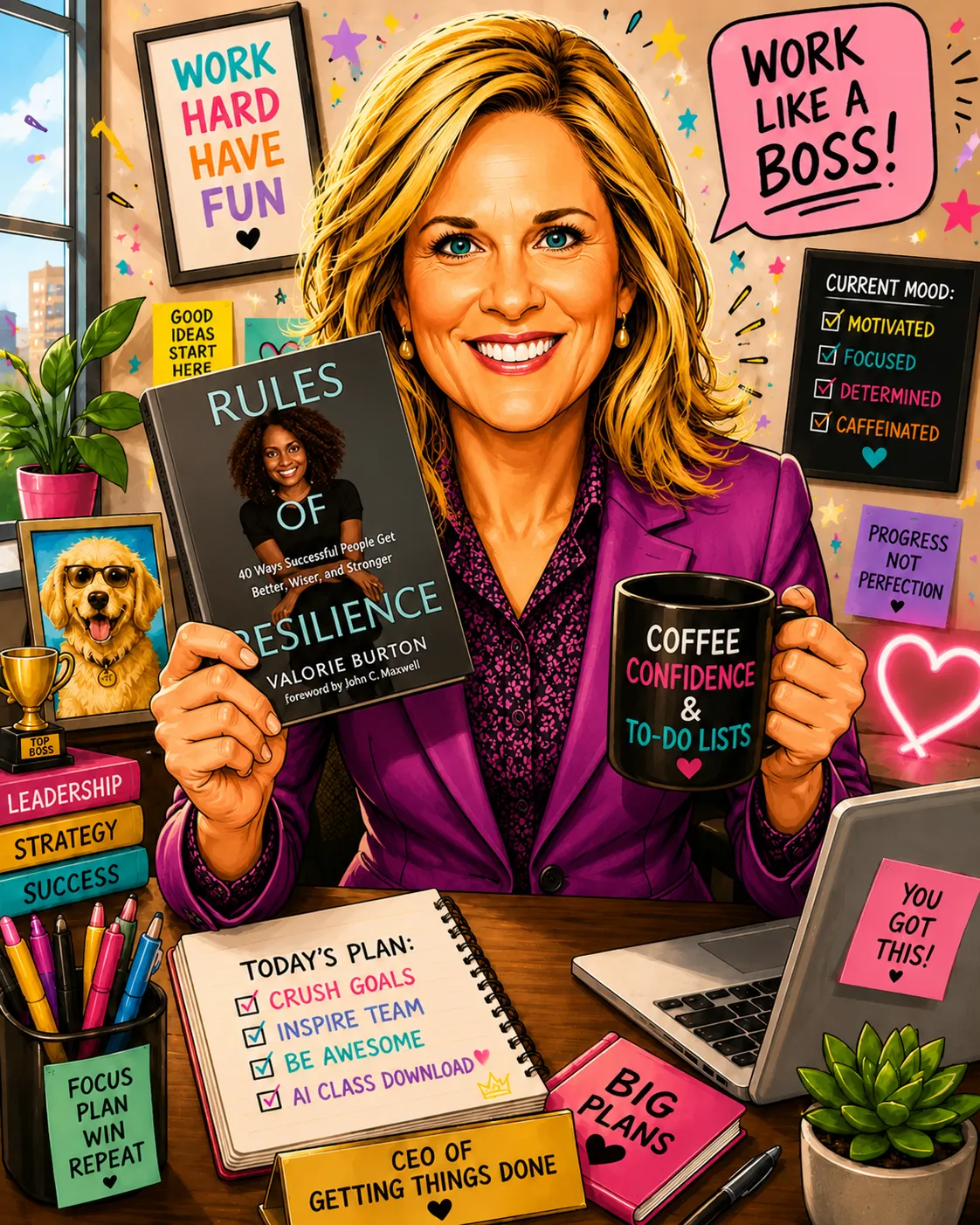
The Resilience Toolkit Every HR Professional Needs
RESILIENCE IN HR SERIES | BLOG 2 OF 2
The Resilience Toolkit Every HR Professional Needs
Practical Frameworks for Navigating the Hardest Parts of This Career with Your Passion Intact
By Reanette Etzler, PHR | The Strategic HR Coach
In Blog 1, we talked about the difference between burnout and the HR Hangover — and why getting that distinction right matters. If you missed it, go read it first. It sets the foundation for everything in this post.
Now we are going to get practical.
Because resilience without tools is just a good idea. And HR professionals — more than almost any other group — need tools that work in real situations, not just inspiration that fades by Tuesday.
Valorie Burton's Rules — Applied to HR
Valorie Burton's Rules of Resilience is one of the most practically useful books I have recommended to coaching clients. Because Burton does not just define resilience — she operationalizes it. Here is how her framework applies directly to the HR professional experience:
Rule 1: Resilient People Have an Accurate View of Themselves
In HR, this means knowing your actual value — not the value your organization's dysfunction is communicating to you, but the real strategic contribution you make. Write it down. Document your wins, your impact, your skills. When the hard days come, you need something concrete to counter the narrative that says you are not enough.
Rule 2: Resilient People Have a Strong Why
Why did you come to HR? Not the job title you were applying for, but the actual reason. The belief that people deserve to be treated well at work. The conviction that organizations can do better. The drive to build something that lasts. Reconnect with that when the day-to-day threatens to bury it.
Rule 3: Resilient People Build and Use Their Support System
Burton is unambiguous about this: resilience is not a solo sport. Yet HR professionals are notoriously isolated — by the nature of the role, by confidentiality requirements, by the perception that they are the support system for everyone else. Build yours. Proactively. A coach, a peer group, a mentor, a trusted colleague in another organization. Someone who knows what this job actually feels like.
Rule 4: Resilient People Take Care of Their Physical and Mental Health
This one tends to get the most eye rolls and the least action. But Burton's research is clear: physical and mental health are not nice-to-haves in the resilience equation. They are load-bearing walls. When they crumble, everything else follows. HR professionals who are serious about sustainability have to be serious about this, even when it feels indulgent.
Rule 5: Resilient People Maintain a Hopeful Outlook
Not naïve optimism. Not toxic positivity. Grounded hope — the belief, backed by evidence, that the situation can improve and that you have agency in that improvement. For HR, this often means keeping sight of what IS working, what HAS changed, and what is possible with the right strategy and tools.
The Strategic HR Resilience Framework
Over years of coaching HR professionals and CEOs, I have developed a framework specific to the demands of this role. It maps to the IMPACT Model and focuses on the four domains where HR resilience most often breaks down:
The Four Domains of HR Resilience:
1. CAPACITY — Managing your workload without losing your mind or your mission
2. INFLUENCE — Maintaining your ability to lead when you have no positional power
3. IDENTITY — Staying connected to who you are when the role tries to define you
4. RECOVERY — Getting back up faster when the inevitable hard things happen
Domain 1: Capacity
The #1 resilience killer for HR professionals is volume. Too much work, too few resources, no end in sight. Capacity resilience is not about doing more. It is about doing less of the wrong things so you can do more of the right things.
Use AI to automate administrative tasks and reclaim strategic hours
Build delegation or triage systems even if you are a department of one
Learn to say 'yes, and here is what that means for other priorities' instead of just yes to everything
Domain 2: Influence
HR often has enormous responsibility and limited formal authority. Influence resilience is about building the relationships, data, and credibility that let you lead without a title.
Learn to present HR initiatives in business language — revenue, risk, retention, ROI
Build alliances with champions in leadership before you need them
Document your impact consistently so the case for HR's value is always ready
Domain 3: Identity
This is the one that takes HR professionals by surprise. When your role is to be all things to all people, it is easy to lose track of who you actually are — your values, your boundaries, your voice. Identity resilience is about staying grounded in yourself even when the job is pulling you in twenty directions.
Revisit your personal values regularly — especially after hard seasons
Maintain boundaries that protect your capacity and your integrity
Know what you stand for — and be willing to stand for it even when it is uncomfortable
Domain 4: Recovery
Recovery resilience is not about bouncing back as if hard things did not happen. It is about integrating hard experiences and coming out with more wisdom, more skill, and more capacity than before.
Debrief your hard experiences intentionally — what happened, what did you learn, what would you do differently
Give yourself permission to feel the difficulty without letting it become your permanent story
Seek support proactively — a coach, a therapist, a trusted community — before you are in crisis
A Note on Resilience and Having a Voice
One of the things I am most proud of in my HR career is that I was never afraid to stand up and have a voice — even when the room pushed back. Even when I was in the minority. Even when standing up cost me something.
That came from resilience. But it also built resilience. Every time I chose to speak up rather than shrink, I got a little stronger. Every time I advocated for what was right rather than what was easy, I trusted myself a little more.
HR professionals are often conditioned to manage conflict rather than engage in it. To smooth things over rather than name the hard truth. To protect the organization from friction rather than introduce productive tension.
That conditioning is not serving you. And it is not serving your organization.
"Your voice is a strategic asset. Using it — clearly, respectfully, and consistently — is one of the most resilient things you can do for your career and for the people you serve."
— Reanette Etzler, The Strategic HR Coach
Your Resilience Action Plan — Starting This Week
Identify one domain — Capacity, Influence, Identity, or Recovery — where you are most depleted right now. Just one. Name it honestly.
Pick one action from that domain's list above. One. Calendar it for this week. Not "when things calm down." This week.
Find one person to share this with — a colleague, a coach, a community — who will ask you next week how it went. Accountability is not weakness. It is strategy.
Read or re-read Valorie Burton's Rules of Resilience. Underline the parts that feel uncomfortably accurate. That discomfort is growth.
Give yourself credit for still being here. Still caring. Still showing up. That is resilience already — and it is worth acknowledging.
"You don't get to choose what happens to you. You do get to choose what you do next. Every single time."
— Valorie Burton, Rules of Resilience
The HR profession needs resilient, growing, strategically capable leaders. Not martyrs. Not machines.
People. With tools. And permission.
You are one of them. Act like it.
Ready to invest in your resilience and your strategic capability?
The Rules of Resilience Mastermind Class is HERE!
Jul 7, 2026 from 11-2 PST
Coaching | Keynote Speaking | AI for HR Crash Course | Strategic HR Consulting
www.thestrategichrcoach.com | [email protected] | 530-520-5775
Sources: Burton, V. (2024). Rules of Resilience. Berrett-Koehler Publishers. | Masten, A. S. (2015). Ordinary Magic: Resilience in Development. Guilford Press. | American Psychological Association (2023). Building Your Resilience.


